Only flush a wipe when the pack carries the recognised flushable symbol and states that the product complies with Australian and New Zealand Standard AS/NZS 5328:2022. A word such as “flushable”, “biodegradable” or “plastic-free” on its own is not enough. When in doubt, bin it.
Wet wipes are convenient because they are designed to remain strong while wet. That same strength is exactly why disposal matters. Unlike toilet paper, many wipes do not lose their structure quickly after entering a toilet. They may travel beyond the bowl but still remain intact inside household pipes, pumping stations or the wider wastewater network.
This does not mean every modern product carrying a flushability claim is automatically unsuitable. Australia and New Zealand now have a specific standard for assessing these products. The practical challenge for shoppers is knowing the difference between a verified claim and general wording that merely sounds reassuring.
01 / THE STANDARD
What “Flushable” Should Mean in Australia
AS/NZS 5328:2022, Flushable Products, was published in May 2022. It provides a framework, test methods and criteria for deciding whether a product is suitable for disposal through a toilet and wastewater system. According to Standards Australia, a product must pass six tests and meet specified labelling requirements before it can declare compliance.
The Water Services Association of Australia explains that the standard is voluntary. That detail matters: the existence of the standard does not mean every package using the word “flushable” has been assessed against it. Look for an explicit declaration of compliance and the recognised flushable symbol—not just prominent marketing language on the front of the pack.
The simplest household rule
Sydney Water advises customers to flush only pee, poo, toilet paper and products that have met AS/NZS 5328:2022. If the pack does not clearly demonstrate compliance with that standard, dispose of the wipe in general waste.
“If the standard is not clearly shown, the bin is the safer destination.”
02 / WHY IT MATTERS
Why Wet Wipes Behave Differently from Toilet Paper
Toilet paper is designed to disperse rapidly after contact with water and movement. Most wipes are designed for the opposite purpose: they need enough wet strength to survive inside a pack, unfold in one piece and remain useful while wiping the skin or a surface.
Wet strength
Fibres and binders can help a wipe remain intact during use, but may also slow its breakdown after flushing.
Time in the pipe
A product may leave the toilet bowl before it has dispersed enough to travel through every part of the system safely.
Snag points
Wipes can catch on rough pipes, tree roots or existing debris and create a place for more material to collect.
Combined blockages
Intact wipes may combine with fats, oils, grease and other unflushable items to form larger obstructions.
That difference is also why a home “jar test” is not a reliable certification method. Shaking a wipe in water cannot reproduce pipe distances, pumps, flow rates, treatment processes or the complete test criteria in AS/NZS 5328.
03 / WORDS THAT GET CONFUSED
Biodegradable Does Not Automatically Mean Flushable
The ACCC states that environmental and sustainability claims should be truthful, accurate and supported by reasonable grounds. For consumers, the best protection is to read the whole disposal instruction rather than relying on a single attractive word.
04 / LABEL CHECK
A 20-Second Check Before You Flush
- 01
Find the disposal instruction
Look on the back or side of the pack for specific directions. Do not assume that a toilet-related use makes the wipe suitable for flushing.
- 02
Look for AS/NZS 5328:2022
The package should clearly declare that the product complies with the Australian and New Zealand Flushable Products Standard.
- 03
Check for the correct symbol
Look for the recognised flushable logo. A custom water droplet, leaf or toilet illustration is not automatically proof of compliance.
- 04
Follow quantity directions
Even a compliant product must be used exactly as directed—for example, one wipe per flush if that is what its instructions specify.
- 05
When uncertain, use the bin
If the declaration is missing, unreadable or ambiguous, do not experiment with your plumbing.
05 / RESPONSIBLE DISPOSAL
Which Wipes Should Go in the Bin?
Unless a product specifically carries the recognised standard declaration, place used wipes in general waste. This includes many everyday categories:
- Baby wipes and nappy-change wipes
- Make-up remover and facial cleansing wipes
- Household cleaning and disinfecting wipes
- Gym, body and instant cooling wipes
- Individually packed wet towels
- Paper towel, tissues and napkins
- Pet-care and surface-care wipes
Keep a small lined bin near the toilet or bathroom vanity so the correct choice is convenient. Used wipes generally do not belong in household recycling. Close or wrap personal-care waste where appropriate, then follow your council’s general-waste instructions.
Glowish product disposal
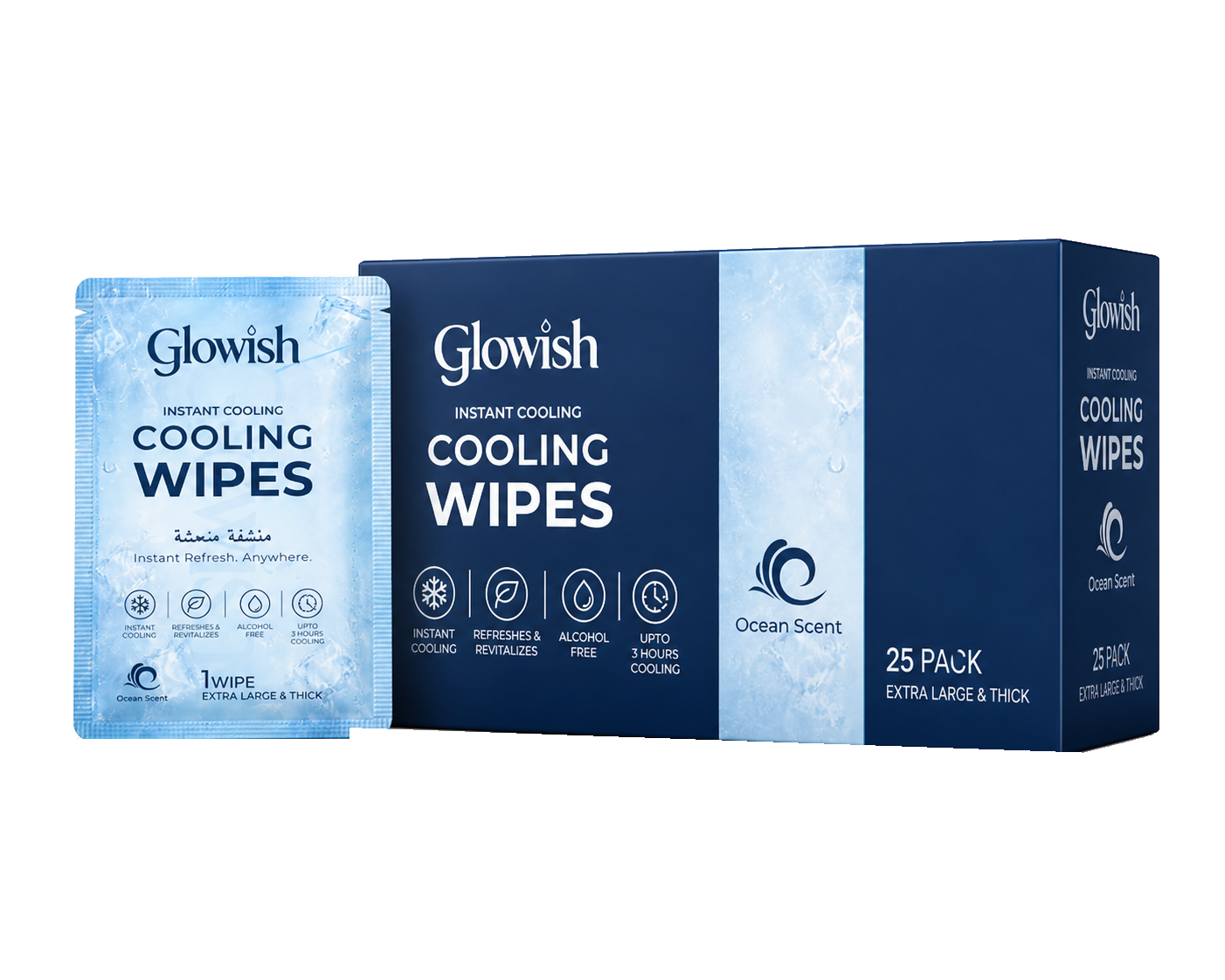
Glowish wet towels and cooling wipes are designed for single use and should be disposed of after use. They are not presented as AS/NZS 5328-compliant flushable products, so place them in a general-waste bin and do not flush them.
06 / WHAT TO DO NEXT
What If You Have Already Flushed a Wipe?
One wipe does not guarantee an immediate blockage, but it is sensible to stop flushing any more. Watch for warning signs such as a slow-draining toilet, a rising water level, gurgling sounds, unpleasant odours or wastewater appearing in another fixture.
- Do not keep flushing to “push it through”.
- Do not add more wipes, tissues or paper towel.
- Do not mix drain-cleaning chemicals or use them without understanding the label and plumbing risk.
- If the toilet is backing up or several fixtures are affected, stop using the affected plumbing and contact a licensed plumber.
- If wastewater is overflowing outside your property boundary, follow the reporting instructions of your local water utility.
Homes using septic or onsite wastewater systems should be especially cautious. Follow the system manufacturer’s guidance and the product label; when either is unclear, bin the wipe.
07 / MYTH OR FACT
Five Common Flushable-Wipe Myths
“It went down, so it is flushable.”
Leaving the bowl only proves that the wipe passed the first section of pipe—not that it dispersed through the entire system.
“Biodegradable means safe for the toilet.”
Biodegradation can require conditions and time that are very different from those inside household plumbing.
“One wipe cannot make a difference.”
A single wipe may catch on an existing obstruction and help other material accumulate around it.
“Australia has a flushability standard.”
AS/NZS 5328:2022 establishes tests and labelling requirements for products that declare compliance.
“The package should provide the proof.”
Consumers should not have to guess. Look for the compliance statement and recognised symbol; otherwise use the bin.
REFRESH RESPONSIBLY
Convenient Care, Clear Disposal
FREQUENTLY ASKED QUESTIONS
Flushable Wipes: FAQs
Can you really flush flushable wipes in Australia?
Only flush a wipe when its packaging clearly states compliance with AS/NZS 5328:2022 and displays the recognised flushable symbol. If you cannot verify both the instruction and standard, put it in the bin.
Are biodegradable wipes safe to flush?
Not automatically. Biodegradability does not show that a wipe disperses quickly enough for plumbing and wastewater systems. Check for AS/NZS 5328:2022 compliance.
Are baby wipes flushable?
Most baby wipes should be placed in general waste unless a particular product clearly declares compliance with AS/NZS 5328:2022. Never assume all wipes in a category behave the same way.
What is the flushable-wipes symbol in Australia?
The Australian and New Zealand standard provides labelling requirements and a recognised symbol for compliant products. Look for that symbol together with an explicit AS/NZS 5328:2022 declaration.
Can I flush one wipe at a time?
Only when the product is compliant and its directions permit it. Limiting the quantity does not make a non-compliant wipe safe to flush.
Can Glowish wet towels or cooling wipes be flushed?
No. Glowish wet towels and cooling wipes should be disposed of in general waste after use and should not be flushed.
Sources and further reading
Standards Australia: AS/NZS 5328 Flushable Products standard
Water Services Association of Australia: Flushable Products Standard Q&A